
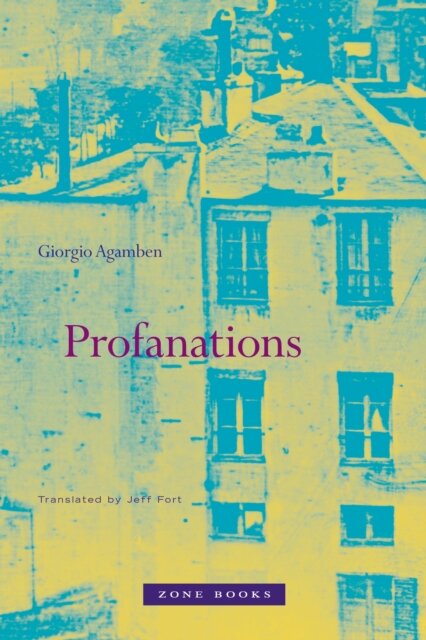
Profanations
€ 26,26
Informação do Produto
| ISBN | 9781890951832 |
|---|---|
| Autores | Giorgio (Accademia di Architettura di Mendrisio) Agamben |
| Editora | Zone Books |
| Formato | Capa mole |
| Número de páginas | 102 |
| Peso (kg) | 0,188 |
| Data de Publicação | 02/03/2015 |
| Preço (iva excl.) | € 24,77 |
| Imposto | € 1,49 |
| Preço (iva inc.) | € 26,26 |
| Disponibilidade | 1 unidade em armazém externo |
Descrição do Produto
The Italian philosopher Giorgio Agamben has always been an original reader of texts, understanding their many rich and multiple historical, aesthetic, and political meanings and effects. In Profanations, Agamben has assembled for the first time some of his most pivotal essays on photography, the novel, and film. A meditation on memory and oblivion, on what is lost and what remains, Profanations proves yet again that Agamben is one of the most provocative writers of our times.
In ten essays, Agamben rethinks approaches to a series of literary and philosophical problems: the relation between genius, ego, and theories of subjectivity; the problem of messianic time as explicated in both images and lived experience; parody as a literary paradigm; the potential of magic to provide an ethical canon.
The range of topics and themes addressed here attest to the very creativity of Agamben’s singular mode of thought and his persistent pursuit to grasp the act of witnessing, sometimes futile, sometimes earth-shattering — the talking cricket in Pinocchio; “helpers” in Kafka’s novels; pictorial representations of the Last Judgment, of anonymous female faces, and of Orson Wells’s infamous object of obsession Rosebud. “In Praise of Profanity,” the central essay of this small but dense book, confronts the question of profanity as the crucial political task of the moment.
An act of resistance to every form of separation, the concept of profanation — as both the “return to common usage” and “sacrifice” — reorients perceptions of how power, consumption, and use interweave to produce an urgent political modality and desire: to profane the unprofanable. In short, Agamben provides not only a new and potent theoretical model but also a writerly style that itself forges inescapable links between literature, politics, and philosophy.