
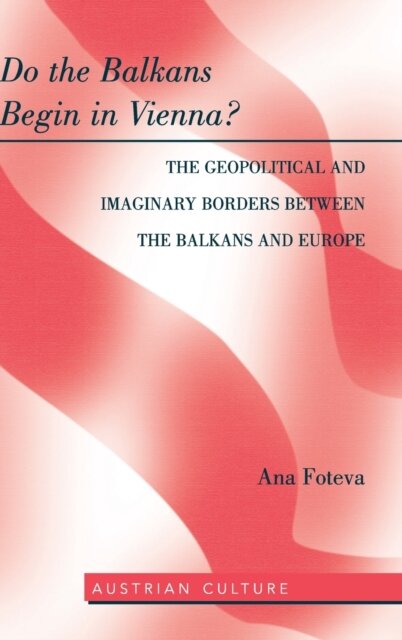
Do the Balkans Begin in Vienna? The Geopolitical and Imaginary Borders between the Balkans and Europe
€ 123,90
Informação do Produto
| ISBN | 9781433115653 |
|---|---|
| Autores | Ana Foteva |
| Editora | Peter Lang Publishing Inc |
| Formato | Capa dura |
| Número de páginas | 332 |
| Peso (kg) | 0,650 |
| Data de Publicação | 22/05/2014 |
| Preço (iva excl.) | € 116,89 |
| Imposto | € 7,01 |
| Preço (iva inc.) | € 123,90 |
| Disponibilidade | 1 unidade em armazém externo |
Descrição do Produto
Do the Balkans Begin in Vienna? takes up one of the most fraught areas of Europe, the Balkans. Variously part of the Austro-Hungarian, Ottoman, and Byzantine empires, this region has always been considered Europe’s border between the Orient and the Occident. Aiming to clarify the politics of drawing cultural borders in this region, the book examines the relations between the Habsburg Monarchy and the Balkans as an intermediate space between West and East. It demonstrates that the dichotomy Orient versus Occident is insufficient to explain the complexity of the region. Therefore, cultural multi-belonging, historical disruption, and recurrence of identities and conflicts are proposed to be «the essence» of the Balkans.
Do the Balkans Begin in Vienna? depicts the fictional imagination of the Balkans as a «utopian dystopia». This oxymoron encompasses the utopian projections of the Austrian/ Habsburg writers onto the Balkans as a place of intact nature and archaic communities; the dystopian presentations of the Balkans by local authors as an abnormal no-place (ou-topia) onto which the historical tensions of empires have been projected; and, finally, the depictions of the Balkans in the Western media as an eternal or recurring dystopia.
There is at present no other study that distinguishes these particular geographical reference points. Thus, this book contributes to the research on Europe’s historical memory and to scholarship on postcolonial and/or post-imperial identities in European states. The volume is recommended for courses on Austrian, German, Balkan, and European studies, as well as comparative literature, theater, media, Slavic literatures, history, and political science.